
Physics: temperature & salinity
What the Workbench does
Ocean temperature and salinity are two of the most fundamental Essential Ocean Variables - they underpin everything from climate monitoring to ocean reanalysis. But the observations come from a patchwork of infrastructures, each with different formats, quality flags and levels of duplication, making it hard to build a single, trustworthy, ready-to-use dataset.
The Physics Workbench solves this by integrating temperature and salinity observations from four major infrastructures - SeaDataNet, Copernicus Marine Service (CORA product), Euro-Argo, and the World Ocean Database - into one harmonised, quality-controlled data lake. At every step the workflow preserves full provenance and lineage: the technicians at sea, the data managers, and the intermediary producers behind every observation remain traceable. The result is a dataset that maximises the availability of good-quality data for a given ocean region while reducing uncertainty in downstream products.
The engine: the Beacon data lake
Like the Eutrophication Workbench, the Physics Workbench is built on Beacon, an open-source data lake query engine. Each of the four source infrastructures gets its own dedicated ("monolithic") Beacon instance, which are then combined into a single merged instance - the workbench's core - where temperature and salinity observations from all sources sit side by side in consistent units and formats.
From there, a sequence of purpose-built tools takes over. The MinMax Alerts tool applies statistical quality control, flagging measurements that fall outside expected physical ranges. The CW Duplicates Tool (CWdt) then scans the harmonised data for potential repeat observations across sources, based on their metadata, and produces a list of duplicates and discards. Finally, the FileForge tool applies these results to generate the finished EOV dataset - in both a duplicate-annotated version and a fully cleaned version - while converting the output into multiple formats. All three tools run as containerised services on Blue-Cloud2026's Cloud Computing Platform, so the pipeline can be re-run consistently as new data becomes available.
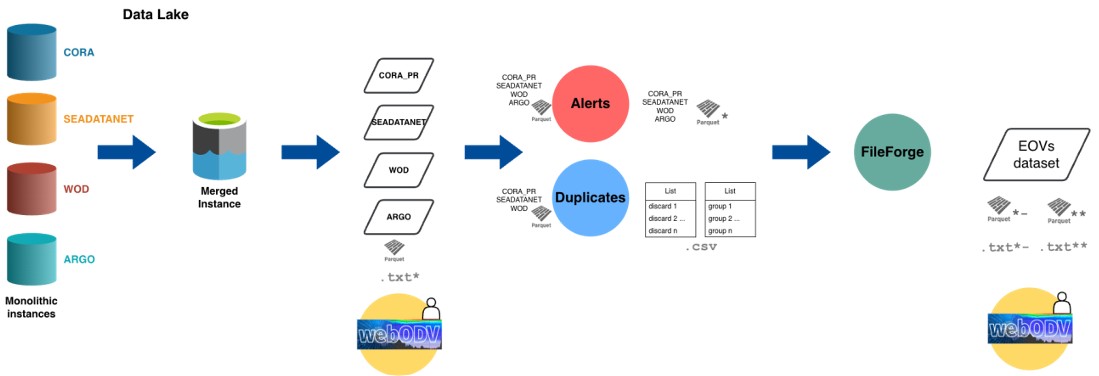
The Physics Workbench pipeline
What it delivers
The Workbench has been implemented as a proof of concept for the Mediterranean Sea, covering 1950 to 2025. It's delivered in two versions - one cleaned of duplicates, one annotated with duplicate and provenance information - and in multiple formats (parquet, ODV spreadsheet and ODV collection), all explorable directly through webODV. The dataset supports uses such as assimilation into ocean reanalysis, and the derivation of multi-year products like climate normals and ocean-monitoring indicators.
The workflow itself is designed to be portable to other ocean regions and time spans; scaling it up to the global ocean is planned as the next phase, and will require additional computational resources and further optimisation.
Learn more about its workflows, tools and user documentation
This task is led by Simona Simoncelli, INGV